
Laos can be explored in different ways – each with its own charm:
By Boat
Huoay Xay – Luang Prabang
Slow Boat
Public slow boats on the Mekong River are the most popular choice. Tickets are available at the boat dock or at agencies in Houay Xay or Chaing Rai (incl. transport to the border in the morning from Chaing Rai). The scenery is spectacular, but the comfort and amenities of the boats vary considerably. For a more comfortable journey, consider booking a private boat.
Public boats depart at 9:00 AM, but they wait for the arrival of organized tour groups from Chiang Rai, Thailand. If you cross the border early, you can reach the boat dock in plenty of time.
Drinks and instant noodle soups are usually available for purchase on public boats. But it is recommended to bring lunch on board. Especially during peak season, they are often packed, especially on the downstream journey from Houay Xay to Laung Prabang.
More spacious and comfortable alternatives include Shompoo Cruise, Mekong Lover Cruise, Luang Say, Le Grand and others.
All slow boats will stop overnight at Pak Beng, the half-way point between Houay Xay and Luang Prabang. Pak Beng offers a large number of guesthouses and some more comfortable hotels.
Speedboat (Rocket Boat)
A faster, but significantly riskier alternative. The trip takes 2.5–3.5 hours each strech, making it possible to cover the whole journey in one day. Fatal accidents do occur occasionally. We cannot recommend the use of the speed boats. If you do decide to take a rocket boat, we strongly recommend wearing a helmet and life jacket.
Muang Khua – Muang Ngoy – Nong Khiaw
Arguably the most beautiful stretch of river in Laos that can be traveled by boat, this 5-6 hour journey on the mostly untamed Nam Ou links the quaint frontier town of Muang Khua to the backpacker and hiker hub of Nong Khiaw. Much of the Nam Ou is still only accessible by water, meaning the daily public boat will often stop at small villages along the way for passengers to get on or off or to deliver goods. Around 1.5-2 hours from Nong Khiaw you have to change boats at a dam with locals offering Tuk Tuk transfers between the two piers.
Public boats depart usually between 9:00 am and 10:00 am. During the rainy season, public boats may not run on a daily schedule.
By Bus
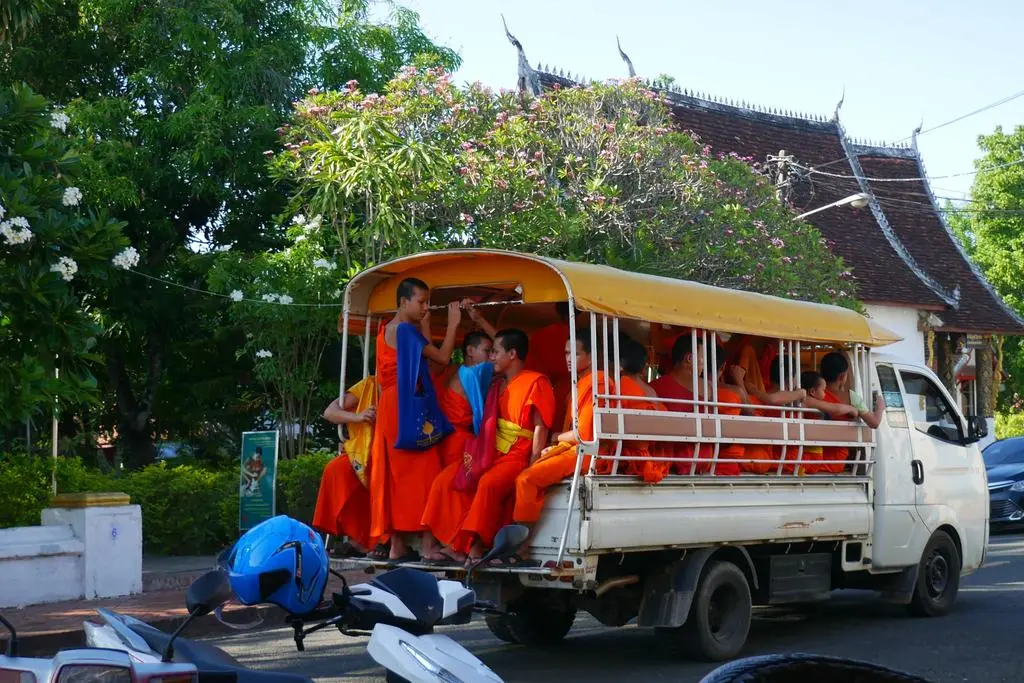
Bus travel is very common in Laos with the following options available:
- Minivans – public or private: For shorter distances.
- Local buses: Inexpensive, but often slow and basic.
- VIP buses and VIP sleeper buses: More comfortable and faster. Especially popular on longer routes such as Vientiane -Thakhek – Savannakhet – Pakse.
Tip: Travel during the day to enjoy the spectacular scenery.
Bus tickets are often not available online – it’s best to inquire at the bus station the day before about current departure times and tickets.
Road conditions in Laos can change rapidly, especially during the rainy season and on roads with heavy truck traffic. Generally, you should always allow extra time for bus travel, especially in Northern Laos.
By Train – the Lao-China-Railway (LCR)
Your Ultimate Guide to Train Travel in Laos
The Lao-China Railway (LCR) has fundamentally transformed travel in this breathtaking country. What was once a grueling, all-day bus journey along winding mountain roads has been replaced by a smooth, high-speed network that traverses the spectacular karst landscapes in a fraction of the time.
Whether you’re speeding from the bustling capital of Vientiane to the charming streets of Luang Prabang or traveling further north to the Chinese border, here’s everything you need to know to ride the rails like a pro.
The Rolling Stock – Combining Speed and Comfort
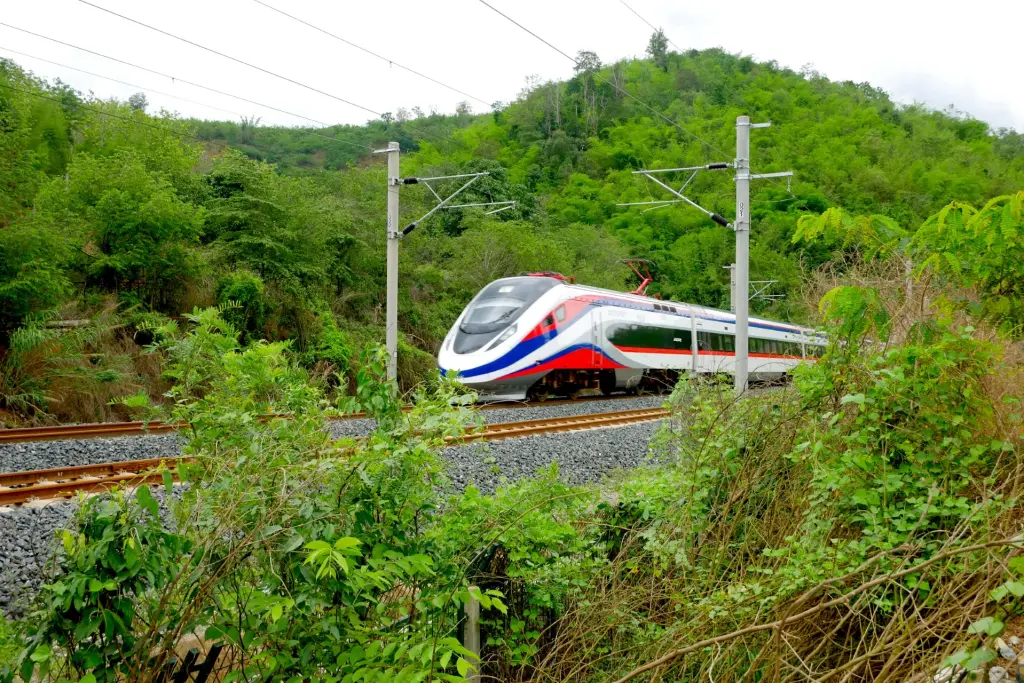
At the heart of the network is the sleek, “China-standard” electric high-speed train (EMU) proudly named Lane Xang (meaning “Million Elephants”). Reaching speeds of up to 160 km/h, this express train offers a remarkably smooth, quiet, and modern ride.
- Capacity & Comfort
The train has nine fully air-conditioned carriages, accommodating up to 720 passengers. The layout includes one first-class carriage (56 premium seats), six spacious and very comfortable second-class carriages, and a dedicated dining car. During peak season, two trains are coupled together to further increase capacity. - Onboard Amenities
You don’t have to worry about your phone running out of power mid-journey – every seat is equipped with a power outlet. The train is also wheelchair accessible, offering special facilities and seating for passengers with disabilities. - Services
Multilingual digital displays and announcements provide information in Lao, Chinese, and English. If you get hungry, a mobile snack cart and the dining car offer a selection of drinks and light snacks. Additionally, there are shops at each station selling instant noodle soups (hot water is available on the train) and snacks.
How to Buy Your Train Tickets
The ticketing system has evolved dramatically, making it much easier for independent international travelers to reserve seats without relying on a local ticket vendor. Regardless of how you choose to book your ticket, you will need your passport (or a photo of it). Lao nationals can use their national ID card.
You can book tickets up to three days or one week in advance, depending on the train category. Even on intermediary websites like 12go.asia or baolau.com, your actual ticket is only purchased and validated by LCR 7 days before your departure. Therefore, there is always a chance that, despite booking through an intermediary, no tickets will be available, and you could end up without one.
The Official LCR Ticket App
The absolute best way to book your trip is to download the official LCR Ticket App (available for iOS and Android). It will show you ticket availability and an up-to-date timetable. Since train schedules can sometimes change at short notice, you should always check them a few days in advance (they shouldn’t change once ticket sales open).
- Best time to book
Domestic ticket sales open promptly at 6:30 a.m., exactly 7 days before your departure date. As train travel in Laos is immensely popular, the coveted seats in the morning during peak season often sell out within minutes. So be prepared to log in promptly at 6:30 a.m.! There’s also often a surge of returned tickets on the day of departure, giving you a chance to book last-minute tickets. - International tickets
Cross-border tickets to China can be purchased up to 14 days in advance. However, you may not be able to book them through the app. Meaning you still have to go to one of the official ticket offices around town or at the train stations. - Payment
The app is very tourist-friendly, allowing foreign travelers to pay directly with international VISA cards or UnionPay, as well as regional digital wallets like Alipay and WeChat Pay. However, there are reports that payments with foreign VISA cards don’t always work smoothly, especially if you’re outside of Laos or China at the time of booking. - Tickets
After successful booking, the app generates an e-ticket QR code. For domestic travel, you can simply have this QR code scanned on your phone at the station—a paper ticket is not required. If you are traveling without a local SIM card or eSIM and rely on Wi-Fi, it is recommended to take a screenshot of the QR code.
Ticket Offices at Train Stations and in Cities
If you prefer a paper ticket or wish to pay in cash, you can visit an official ticket office. These are located at every train station and in the city centers of Vientiane and Luang Prabang. The opening hours of the ticket offices at the train stations are usually based on train departure times. The ticket offices in the city centers are generally open from 8:00 AM to 12:00 PM and from 1:00 PM to 5:30 PM. A service fee of 20,000 kip per ticket is charged.
Be sure to bring passports or copies/photos for each passenger, as passport numbers and names will be printed on the paper ticket. Keep your paper ticket safe throughout your journey, as it will also be scanned at the arrival station – losing it may result in a fee equal to the maximum fare.
At the train station – procedures and security checks
The larger train stations are massive, architectural masterpieces, but they are subject to strict logistical rules and are usually located quite far outside the city centers.
- When you should arrive
Plan to be at the station at least half an hour before departure if you already have your app QR code or paper ticket. If you have to queue to buy a ticket or print a physical ticket, allow two hours as the counters at the train stations can be very busy. Don’t forget to factor in travel time to the train station, especially during rush hour (around 45-60 minutes from Vientiane city center; 30-45 minutes from Luang Prabang city center). - The waiting time
The interiors and waiting areas of the train stations will only be opened shortly before the scheduled train departures. There is little shade and little public seating outside the departure hall, so it’s not an ideal location for long waits. Fortunately, external public toilets are available for a small fee. - Strict security screenings
The LCR’s security measures are similar to airport protocols. Items such as pocket knives (including Swiss Army knives), aerosol cans (including sunscreen sprays, deodorant sprays and shaving cream), and flammable materials are strictly prohibited. Security personnel confiscate these items at the scanner. So it’s better to pack pump sprays or creams and leave the pocket knife at home! Hotels and guesthouses are usually able to pre-ship valuable items that are not allowed on the train to your next domestic destination. - Luggage
The high-speed trains have small luggage racks above the seats and additional space near the doors for larger luggage. The slower “K-trains” offer larger luggage racks.
By Plane
Many provincial capitals are also accessible by plane. Vientiane’s Wattey International Airport is the hub for almost all domestic flights. Especially in the mountainous north and in areas far from the railway line, long transfers can be significantly shortened this way.
Most domestic airlines operate daily.
Traveling with Children in Laos
Laotians love children! Young travelers will find playmates everywhere and often receive special attention.
Diapers and baby food are available in the cities – when traveling to rural areas, it’s advisable to pack supplies. It’s also a good idea to carry some biscuits for older children, in case they haven’t yet become familiar with Laotian cuisine.
Important tips: Wash your hands regularly, use hand sanitizer, and observe basic hygiene rules.